
Arakan Army’s Actions Against Rohingya May Amount to Crimes Against Humanity
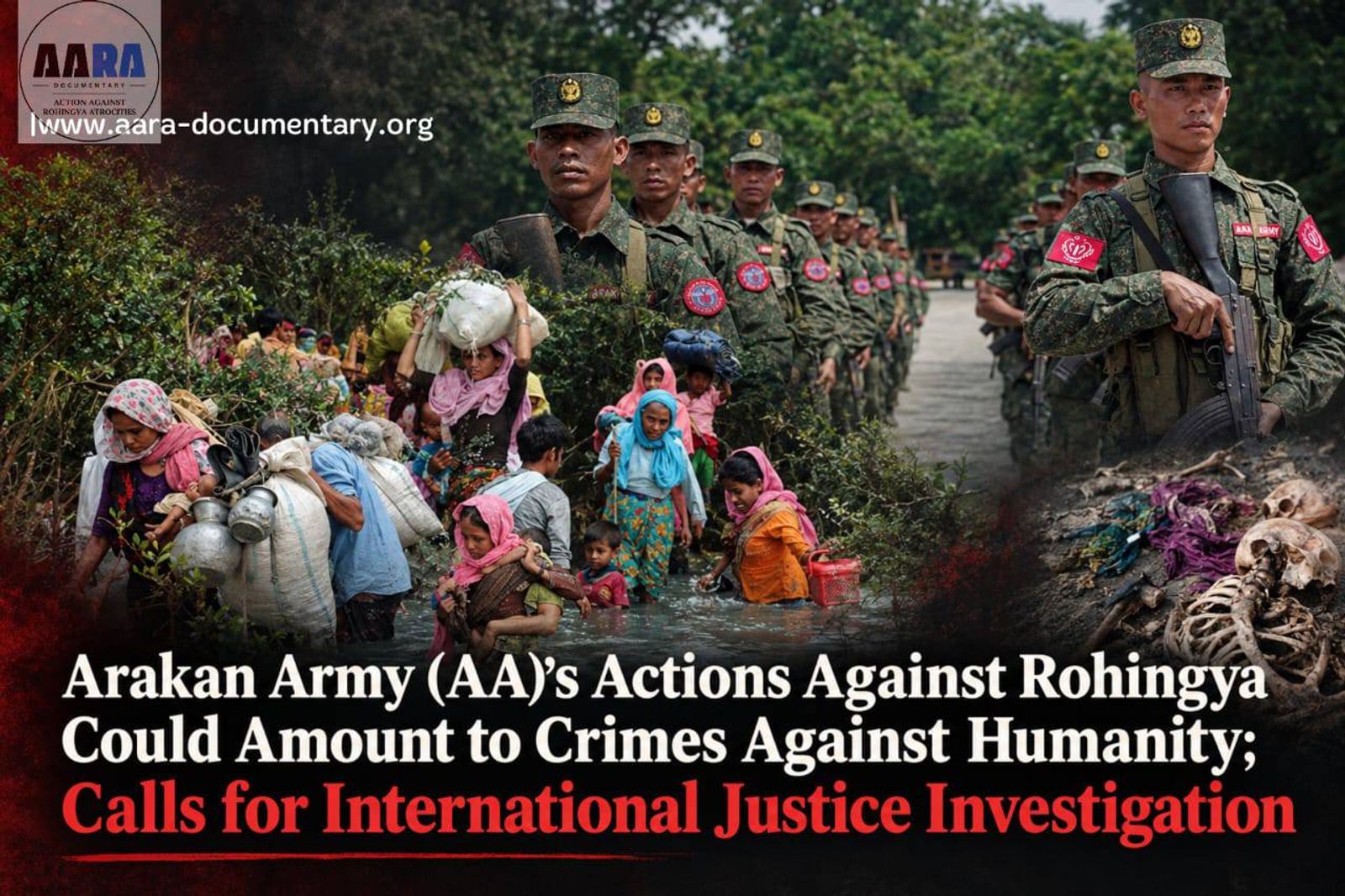
International human rights lawyer Ashley S. Kinseth argues that the Arakan Army’s restrictions, forced labor, taxation, and land confiscation targeting Rohingya warrant investigation as possible crimes against humanity, including ethnic persecution, and calls for greater international accountability.
Cox's Bazar, October 21, 2026:
International human rights lawyer Ashley S. Kinseth has assessed that movement restrictions, taxation, forced labor, and land confiscation imposed by the Arakan Army (AA) on Rohingya in northern Rakhine State should be investigated as crimes against humanity, including ethnic-based persecution. She urges that these actions should not be viewed merely as isolated incidents but examined under international criminal law as a systematic pattern of repression affecting Rohingya.
In an article titled "Crimes Against Humanity in Myanmar's Rakhine State: The Arakan Army's Own Case," published in two parts on October 21 on the international law website Opinio Juris, the author examines from a legal perspective the AA's administrative mechanisms, restrictions on Rohingya, and the possibility of investigation by the International Criminal Court (ICC).
According to the article, after the AA took control of most areas of Rakhine State in 2024, it has imposed a permit system, taxation, and labor quotas on Rohingya in northern Rakhine. In some areas, taxes are being collected on homes, shops, boats, fishing nets, buffaloes and cattle, and rice fields, and even travel to neighboring villages requires permits and money, according to local residents' accounts cited in the article. The UN Office of the High Commissioner for Human Rights has also expressed concern over unjust taxation specifically targeting Rohingya and systematic movement restrictions.
The author writes that after the AA took control of Buthidaung and Maungdaw townships in 2024, Rohingya who had been displaced are facing difficulties in returning to their homes. The article cites UN reports that in some areas, new settlements are being built for other communities on Rohingya land, people are being resettled within 11 former Rohingya villages, and village names are being changed. Changes in land use and their impact on Rohingya returns are important points in the author's legal analysis.
The article also states that forced labor of Rohingya is occurring. According to village-based manpower quotas, people are pressured to work a specified number of days per week or month, and some are made to do construction work without pay, according to witness accounts cited. The article also states that in February 2025, survivors of the Hoyyar Siri incident were moved to the AA-controlled Nasar Para camp, where they cannot leave without permission and work without pay.
The author also includes incidents of Rohingya civilians being killed in 2024. The AA has denied responsibility in those incidents. The article cites that the Independent Investigative Mechanism for Myanmar (IIMM) is investigating allegations of sexual violence against Rohingya women, extrajudicial killings, and forced recruitment of children.
The author's main legal analysis is that these actions may constitute a systematic repression that cannot be fully described by viewing them only as war crimes. In defining crimes against humanity, a widespread or systematic attack on a civilian population and acting pursuant to an organizational policy are important factors. The author assesses that since the AA is an organization that governs many areas and can systematically administer permits, taxes, and labor quotas, it should be investigated whether these actions are linked to an organizational policy.
The article states that persecution on ethnic grounds, in particular, is a legal category that can explain the situation affecting Rohingya. Under international law, this crime includes severe deprivation of fundamental rights on ethnic or religious grounds and the connection of such acts to another specified crime. The author assesses that restrictions affecting Rohingya's freedom of movement, land ownership rights, freedom of religion, and right to maintain their ethnic identity may potentially meet these criteria.
The article also discusses the AA's security concerns. The author acknowledges that in 2024, some Rohingya armed groups collaborated with the military junta, and the military also recruited thousands of Rohingya men into militia forces. However, it is also assessed that such circumstances would not legitimize mass repression of Rohingya, ethnic-specific taxation, and forced preparation of land for others through forced labor.
Regarding international justice, although Myanmar is not a member of the Rome Statute of the ICC, the author explains that there is a pathway for forced displacement of Rohingya from Myanmar to Bangladesh to fall under ICC jurisdiction, as it is a cross-border crime. The article states that ICC judges decided in 2018 that the court may have jurisdiction over displacement that begins in Myanmar and ends in Bangladesh, and that related persecution could also potentially be investigated.
The article states that according to UN reports, nearly 150,000 Rohingya have arrived in Bangladesh since early 2024. The author assesses that displacement is not only forcible expulsion at gunpoint but that situations where people leave due to threats, pressure, and unbearable living restrictions can also be legally defined as forced displacement.
Therefore, the author urges that the AA's actions should also be considered within the ICC's investigation into Myanmar. However, the article clarifies that the ICC's current investigation is based on crimes related to Bangladesh and that it cannot be said to automatically have jurisdiction over all acts occurring within Myanmar.
The author assesses that if the AA wishes to be recognized as an organization governing Rakhine State, it must respect fundamental human rights in exercising administrative power and must also be accountable for acts it is accused of committing.
The article is a legal analysis by an international human rights lawyer.
The article's author, Ashley S. Kinseth, is an international human rights lawyer who focuses on international human rights and crimes against humanity, and statelessness issues. She has studied the Rohingya issue and the situation in Myanmar, and has also conducted field research within Rakhine State and in Rohingya refugee camps in Bangladesh and India.
Source — Ashley S. Kinseth, Opinio Juris, "Crimes Against Humanity in Myanmar's Rakhine State: The Arakan Army's Own Case (Part I & II)," October 21, 2026.
Latest news
Arakan Army’s Actions Against Rohingya May Amount to Crimes Against Humanity
International human rights lawyer Ashley S. Kinseth argues that the Arakan Army’s restrictions, forced labor, taxation, and land confiscation targeting Rohingya warrant investigation as possible crimes against humanity, including ethnic persecution, and calls for greater international accountability.

AARA Alleges 51 Rohingya Civilians Detained, Elderly Man Killed in Rathedaung Township by Militant Arakan Army (AA)
Rohingya villagers face urgent concerns over a reported deadline imposed by the militant Arakan Army (AA) to leave their homes by October 17, 2026, raising fears of further displacement and loss of shelter.
1,500 Myanmar Nationals Deported from Malaysia Aboard Junta Warships Amid Airstrike Horror
Malaysia has begun deporting around 1,500 Myanmar nationals despite ongoing conflict, forced conscription risks, and warnings that safe and dignified return remains impossible.
August 25 and the Hindu Massacre Narrative: How the Arakan Army Is Shifting Blame Toward Rohingya and ARSA
The article examines how the Arakan Army's August 25, 2026 Hindu commemoration presents the 2017 Hindu massacre as an ARSA crime, raising questions over efforts to shift blame onto Rohingya and reshape the history of the Rohingya genocide.